News On Japan

A Breakthrough in Aquaculture: Mackerel that Produce Tuna

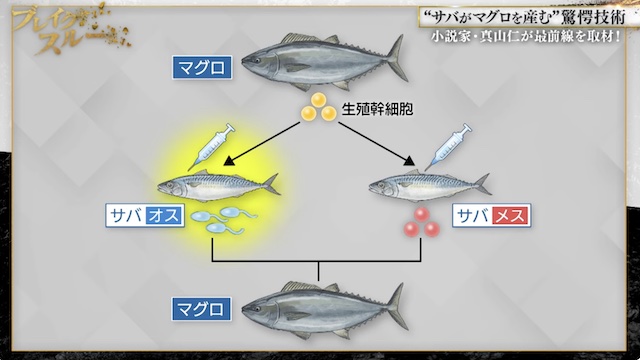
TOKYO - Novelist Hitoshi Mayama explores a groundbreaking next-generation aquaculture technology at Tokyo University of Marine Science and Technology with Professor Goro Yoshizaki. This innovative method allows desired fish species to be bred by transplanting their reproductive stem cells into surrogate fish.
A Breakthrough in Aquaculture: Mackerel that Produce Tuna

Mayama interviews pioneers who started the startup "Fish Dream" last July, discussing the technology's current status and its business potential.

In the heart of Tokyo lies a university that conducts cutting-edge fisheries research. "Initially, I was skeptical about the idea of mackerel producing tuna, but after talking to them, I realized it all comes down to human ego, how we manipulate nature, and the importance of passion in these endeavors," Mayama reflected during his investigation.

As black tuna faces extinction, the potential of reviving extinct fish species or radically changing current aquaculture practices grows. The key lies in mysterious objects contained within small tubes, where essential cells sleep, potentially reshaping the history of the fisheries industry.

"We're making a surrogate fish that can produce the offspring of another species," explains Yoshizaki, who has been researching fish farming techniques for over 30 years. This surrogate parent technology could lead to the creation of completely new fish from existing species.

Yoshizaki's work at Tokyo University of Marine Science and Technology involves developing technologies that are closely watched worldwide. He has achieved a first in the world by increasing reproductive cells in the lab, aiming to solve significant issues like the potential extinction of Pacific black tuna by letting mackerel produce tuna.

The challenges are complex, involving the creation of sperm and eggs from different fish species, a process taking two decades. Yoshizaki humorously notes, "We always say 'another five years,' but it’s not a joke; it’s about how we foresee the timeline for our experiments."

This pioneering journey continues as they aim to revolutionize aquaculture by turning ideas once considered impossible into reality, navigating uncharted scientific territories without a map.

Source: テレ東BIZ

News On Japan
POPULAR NEWS

Japan's World Cup campaign begins on June 14 when the Samurai Blue face the Netherlands at Dallas Stadium in Texas, a clash that will showcase some of the game's most talented players and pit two ambitious teams against one another in a crucial Group F opener. While Japan arrives without injured winger Kaoru Mitoma, one of its most recognizable stars, the squad still boasts a wealth of talent drawn from Europe's top leagues.

The Japan Meteorological Agency (JMA) announced that an El Niño phenomenon is believed to have developed this spring, warning that Japan is likely to experience above-average temperatures nationwide this summer despite the climate pattern's traditional association with cooler summers.

Narita International Airport Corporation is expected to announce next month that it will apply to the national government for project certification as part of the process to enable compulsory land acquisition for the construction of a new runway at Narita Airport, according to sources familiar with the matter.

A fire broke out at Arima Inari Shrine near the Arima Onsen hot spring resort area in Kobe on the night of June 9th, destroying multiple buildings and leaving an elderly Shinto priest and his wife with minor injuries.

Japan's national soccer team arrived in Nashville, Tennessee, on June 8th from Monterrey, Mexico, where it had been conducting a pre-World Cup training camp, and held its first practice session at its base camp for the FIFA World Cup in North America.

MEDIA CHANNELS
         

MORE Business NEWS

The Bank of Japan is set to raise its policy interest rate from 0.75% to 1.0% at its monetary policy meeting on June 15th and 16th, a move that could mark another step in the central bank's gradual shift away from ultra-loose monetary policy as inflation remains elevated and the yen continues to weaken.

The contemporary corporate field across Japan is undergoing a profound digital transformation as forward-thinking organizations strive to maintain their market competitiveness in a globalized economy.

Japan's corporate goods prices rose 6.3% in May from a year earlier, marking the fastest pace of increase in more than three years as higher oil and petrochemical costs linked to tensions in the Middle East pushed up wholesale prices.

The Bank of Japan is increasingly expected to raise its policy interest rate to 1.0% at next week's monetary policy meeting, responding to growing concerns that inflation could rise faster than previously anticipated due to soaring oil prices and other cost pressures.

The number of restaurant bankruptcies in Japan reached a record high for the January–May period, highlighting mounting pressures from rising costs, labor shortages, and increasingly cautious consumer spending.

Casio Computer, the company behind some of Japan’s most iconic consumer electronics including calculators, digital cameras, electronic musical instruments, and the G-SHOCK watch, is pursuing a new strategy aimed at reviving its tradition of product innovation.

Nippon Steel plans to invest up to $2.5 billion, or approximately 400 billion yen, over the next three years in the Mon Valley Works steel complex in Pennsylvania, one of the key facilities operated by U.S. Steel, the American steelmaker it acquired in 2025.

Japan's economy grew at an annualized rate of 1.8% in the January–March quarter of 2026, according to revised gross domestic product (GDP) data released by the Cabinet Office, with the figure marked down from the preliminary estimate due largely to weaker-than-expected capital investment.