News On Japan

Japan's Top Five Securities Firms See Significant Profit Increase

TOKYO - The earnings reports from Japan's five major securities firms are in, showing strong performances boosted by the rising stock market.
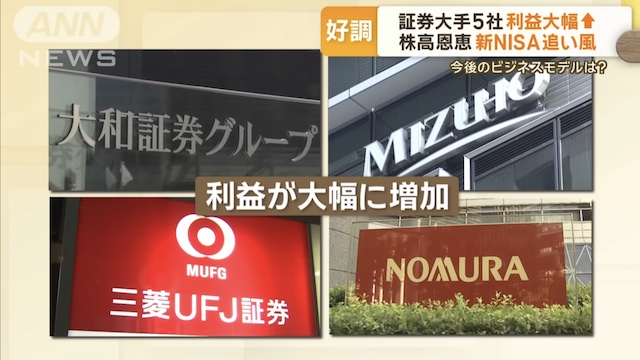
Japan's Top Five Securities Firms See Significant Profit Increase

New NISA Launch Expands Customer Base

The stock market, which hit its highest levels in 34 years last month, has benefitted these firms significantly. SMBC Nikko Securities announced on April 30th that it had reversed a previous loss of 39.8 billion yen, posting a profit of 16.2 billion yen this period. The other four firms also reported significant profit gains.

Increased stock prices have led to higher revenue from transaction fees on stocks and investment funds. Additionally, the launch of the new NISA in January has broadened their customer base.

However, despite the rise in revenue, it still does not compare to the levels seen during the bubble period.

Why the Change?

"In the past, fees were a major source of revenue for securities firms. However, since the 2000s, the rise of online brokerages, which operate without physical branches, has led to rapid fee reductions," states a 40-year-old investor, explaining why they switched to online securities.

"Affordability matters," adds a 20-something investor.

In the fall of last year, SBI Securities and Rakuten Securities made a significant move by eliminating trading fees for domestic stocks altogether.

Cost-conscious individual investors have migrated to these online platforms, eroding the traditional fee-based business model.

"I initially opened my account a long time ago at a physical securities firm where I could get detailed advice in person, which was beneficial. But now, I find online brokerages more convenient," shares another 40-year-old investor.

What's Next for the Business Model?

Experts suggest that traditional brokerages need to differentiate from online platforms and establish business models targeting wealthier clients.

"Transitioning from transaction-based fees to asset management, where clients entrust large sums, could be crucial," suggests Shingo Ide, Chief Researcher at Nissay Basic Research Institute. "Wealthy clients, for example, might deposit sums like 100 million or 1 billion yen, which can secure steady income for securities firms with less labor."

Globally, some securities firms focusing on wealth management for the affluent are already achieving extraordinary profits, and Japanese majors are expected to adopt similar strategies.

Source: ANN

News On Japan
POPULAR NEWS

Japan's World Cup campaign begins on June 14 when the Samurai Blue face the Netherlands at Dallas Stadium in Texas, a clash that will showcase some of the game's most talented players and pit two ambitious teams against one another in a crucial Group F opener. While Japan arrives without injured winger Kaoru Mitoma, one of its most recognizable stars, the squad still boasts a wealth of talent drawn from Europe's top leagues.

The Japan Meteorological Agency (JMA) announced that an El Niño phenomenon is believed to have developed this spring, warning that Japan is likely to experience above-average temperatures nationwide this summer despite the climate pattern's traditional association with cooler summers.

Narita International Airport Corporation is expected to announce next month that it will apply to the national government for project certification as part of the process to enable compulsory land acquisition for the construction of a new runway at Narita Airport, according to sources familiar with the matter.

A fire broke out at Arima Inari Shrine near the Arima Onsen hot spring resort area in Kobe on the night of June 9th, destroying multiple buildings and leaving an elderly Shinto priest and his wife with minor injuries.

Japan's national soccer team arrived in Nashville, Tennessee, on June 8th from Monterrey, Mexico, where it had been conducting a pre-World Cup training camp, and held its first practice session at its base camp for the FIFA World Cup in North America.

MEDIA CHANNELS
         

MORE Business NEWS

The Bank of Japan is set to raise its policy interest rate from 0.75% to 1.0% at its monetary policy meeting on June 15th and 16th, a move that could mark another step in the central bank's gradual shift away from ultra-loose monetary policy as inflation remains elevated and the yen continues to weaken.

The contemporary corporate field across Japan is undergoing a profound digital transformation as forward-thinking organizations strive to maintain their market competitiveness in a globalized economy.

Japan's corporate goods prices rose 6.3% in May from a year earlier, marking the fastest pace of increase in more than three years as higher oil and petrochemical costs linked to tensions in the Middle East pushed up wholesale prices.

The Bank of Japan is increasingly expected to raise its policy interest rate to 1.0% at next week's monetary policy meeting, responding to growing concerns that inflation could rise faster than previously anticipated due to soaring oil prices and other cost pressures.

The number of restaurant bankruptcies in Japan reached a record high for the January–May period, highlighting mounting pressures from rising costs, labor shortages, and increasingly cautious consumer spending.

Casio Computer, the company behind some of Japan’s most iconic consumer electronics including calculators, digital cameras, electronic musical instruments, and the G-SHOCK watch, is pursuing a new strategy aimed at reviving its tradition of product innovation.

Nippon Steel plans to invest up to $2.5 billion, or approximately 400 billion yen, over the next three years in the Mon Valley Works steel complex in Pennsylvania, one of the key facilities operated by U.S. Steel, the American steelmaker it acquired in 2025.

Japan's economy grew at an annualized rate of 1.8% in the January–March quarter of 2026, according to revised gross domestic product (GDP) data released by the Cabinet Office, with the figure marked down from the preliminary estimate due largely to weaker-than-expected capital investment.