News On Japan

Red Gate Remains Shut for Tokyo University Students

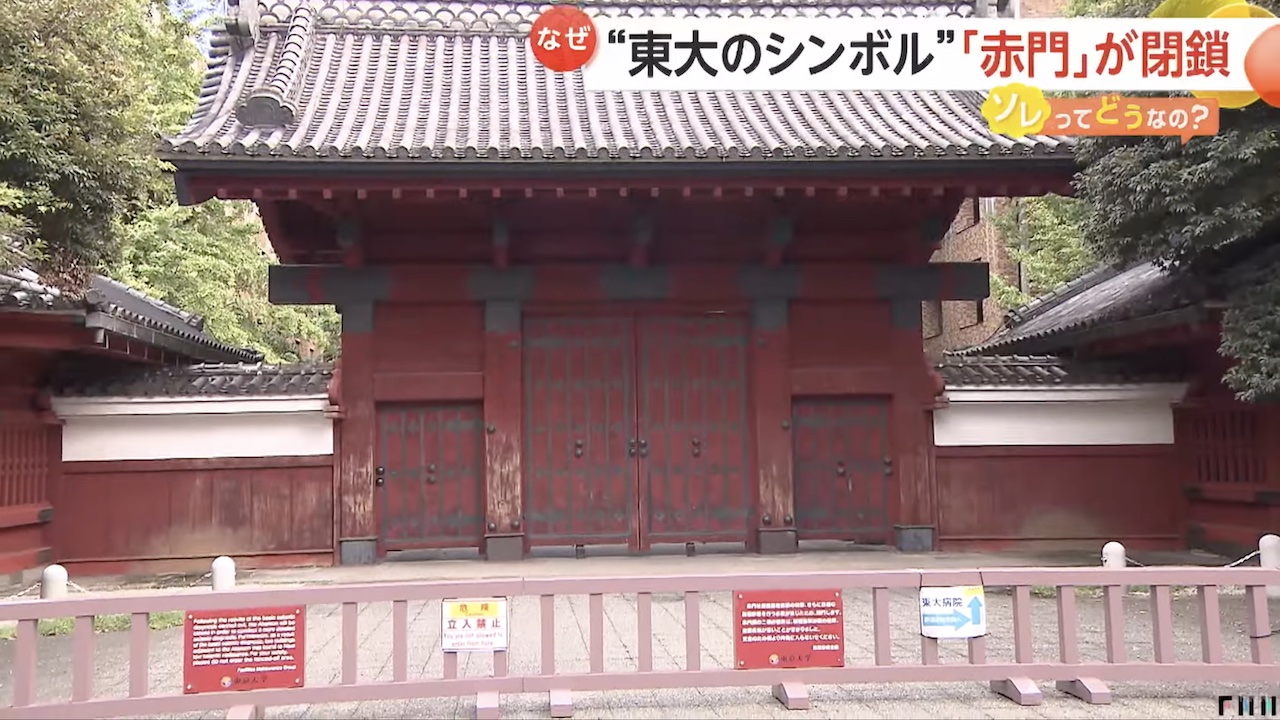
TOKYO, Oct 07 (News On Japan) - Tokyo University's iconic Red Gate, which has long been a symbol for prospective students to pass through, has remained closed for the past three years, leaving many students unable to experience walking through it.

The gate has become known as a significant landmark for students aiming to pass the university's entrance exams. However, the reality is that the Red Gate has been closed for three years now, preventing even current students who passed the exams from experiencing it.

Visiting the site, broadcaster Minoru Aoi found the Red Gate shut, with "No Entry" signs displayed prominently. Curious about the students' thoughts on this situation, he conducted interviews with several individuals.

When asked if they had ever passed through the Red Gate, a graduate student replied, "I joined Todai as a graduate student, so I've never seen it open." To the question of what the Red Gate represents to Todai students, the student described it as "a mascot or symbol." The student expressed a desire to see the gate open at least once: "I'd like to see it open just once."

Another student, reflecting on the timing of their entrance during the COVID-19 pandemic, also mentioned they had never seen the Red Gate open. When asked if they wanted to walk through it, they responded, "I used to have that urge, but not anymore." Another added, "I went to see it once, but it left me feeling a bit down."

The Red Gate's historical significance dates back to the Edo period when the area was the Edo residence of the Maeda family, rulers of the Kaga Domain. Officially named the Former Kaga Residence Guard House Gate, it was constructed in 1827, nearly 200 years ago. Despite surviving the Meiji Restoration, the Great Kanto Earthquake, and air raids during World War II, the gate was designated a National Treasure in 1931 and is now recognized as an Important Cultural Property.

The closure of the gate is due to concerns about its seismic resistance. Experts investigating the structure of the roof tiles found that the gate might collapse in the event of a major earthquake or strong winds. Tokyo University plans to keep the gate closed until it can ensure its seismic safety, aiming to reopen it in three years, coinciding with the university's 150th anniversary.

However, students are currently more concerned about a different issue—tuition hikes. In 2025, Tokyo University announced it would increase the annual tuition fees by approximately 110,000 yen, raising the total to 642,960 yen. While the tuition for current students remains unchanged, the news has sparked protests. One student remarked, "There will definitely be people who are affected by the increase. Although there were opportunities for dialogue, there was not enough widespread communication afterward, raising trust issues."

The university plans to improve the educational environment with the tuition hike, expanding tuition exemption eligibility from households with annual incomes of up to 4 million yen to those earning up to 6 million yen. Additionally, partial exemptions will be offered to families with incomes up to 9 million yen, depending on their circumstances.

Source: FNN

News On Japan
POPULAR NEWS

Bear sightings across Japan have already climbed to nearly twice the level recorded during the same period last year, prompting entry bans in mountain areas behind Kyoto’s Ninna-ji Temple and the cancellation of hiking events in Kansai, while new research suggests that the key to reducing encounters may lie in understanding what bears eat in each region.

Copper roofing panels were stolen from several shrines in Hamamatsu, Shizuoka Prefecture, including a city-designated cultural property, in the latest case amid a nationwide surge in copper thefts targeting shrines and temples across Japan, where soaring metal prices have fueled crimes that leave historic religious buildings damaged, exposed to the elements, and facing repair costs of millions of yen.

Flames broke out on the morning of May 20th on Miyajima Island in Hiroshima Prefecture, home to one of Japan's World Heritage sites, destroying Reikado Hall near the summit of Mount Misen.

Uncertainty surrounding the situation in the Middle East is beginning to affect daily life in Japan, as concerns over crude oil supplies spread to restaurants, cleaning services and even household garbage disposal systems across the Kansai region.

A 25-year-old woman arrested as a suspected ringleader in a robbery-murder case in Tochigi Prefecture once posted cheerful dance videos on social media and was remembered by those who knew her as an energetic and outgoing young woman.

MEDIA CHANNELS
         

MORE Education NEWS

A mother wild boar was filmed on a university campus leaving five piglets to scale a wall on their own, offering a rare glimpse of what one lecturer described as "Spartan" parenting in the wild as baby animals appear across Japan with the arrival of the season.

A former instructor at a major cram school chain has been arrested for allegedly taking the Eiken English proficiency test on behalf of a student and using the score fraudulently in a university entrance examination, with investigators revealing an elaborate scheme involving manipulated facial photographs.

Getting consistent Japanese speaking practice has historically meant enrolling in a class, hiring a tutor, or finding a native speaker willing to meet on a regular schedule.

A previously unidentified landform believed to be a "square earthen platform" has been discovered in the front section of the Daisen Kofun in Sakai, Osaka Prefecture, the Imperial Household Agency revealed on May 17th, raising the possibility that the structure may have been used as a burial facility.

Changes are emerging within PTAs that support children's school lives as growing numbers of dual-income households make it increasingly difficult for parents to participate in traditional school activities.

As the number of foreign residents living in Japan continues to rise, so too does the number of foreign children attending Japanese schools, prompting educators to strengthen support not only for language learning but also for cultural adaptation.

The remains of Ainu people held at the Natural History Museum in London were returned to Japan, marking the fourth case of repatriation of remains taken overseas.

The rapid spread of artificial intelligence into classrooms is transforming how students learn and how teachers work, with pilot programs across Japan highlighting that the key lies not in relying entirely on AI but in using it effectively.