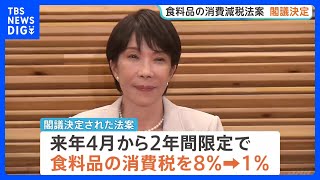
TOKYO - With the House of Representatives election officially kicking off on January 27, seven party leaders appeared on Fuji TV’s “Sunday Report THE PRIME” to debate how quickly they could deliver the consumption tax cuts many are promising as a response to rising prices, along with the rationale for the snap dissolution and Japan’s security policy as tensions with China persist.
The program featured Liberal Democratic Party President Sanae Takaichi, Japan Innovation Party co-leader Fumitake Fujita, Centrist Reform Alliance co-leader Yoshihiko Noda, Democratic Party for the People leader Yuichiro Tamaki, Japanese Communist Party Chair Tomoko Tamura, Reiwa Shinsengumi co-leader Akiko Oishi and Sanseito leader Sohei Kamiya, with all seven parties saying they are campaigning on pledges to cut or abolish the consumption tax as voters focus on inflation and household costs.
Asked whether they would implement a reduction in the consumption tax on food within fiscal 2026 if they took power, Tamaki’s party declined to raise its hand, arguing it opposed cutting the tax only on food, while the other six parties said they would deliver the measure and laid out their reasoning, with the discussion quickly turning to the practical and fiscal hurdles of designing a food-only tax cut.
The debate also opened with sharp exchanges over the legitimacy of the dissolution itself, after Takaichi framed the snap election as necessary to seek a new mandate for major policy shifts, including what she described as a turn toward “responsible, proactive fiscal policy,” a strengthening of security policy and a bolstering of intelligence capabilities, arguing such changes could divide public opinion and therefore required clear voter backing.
Noda countered that the reason for dissolving remained unclear, noting that another election would again cost roughly 70 billion yen and arguing that issues that could split public opinion should be decided through thorough deliberation rather than by a single leader, while Tamaki said he would have preferred the government to first pass the budget and key legislation before calling an election, warning that unresolved bills could disrupt policy changes due to take effect from April.
Oishi attacked the move as a “selfish dissolution,” saying it risked undermining budget deliberations and could even make voting harder during winter conditions, while Fujita defended the dissolution, saying the governing framework had changed and that asking voters to judge a major policy shift was the clearest possible justification, adding that his party still intended to pursue its long-standing proposal to reduce the number of lawmakers after the election.
As the discussion returned to consumption tax policy, Tamaki warned that a food-only cut could create significant administrative and business burdens depending on whether it was structured as a non-taxable transaction or a zero-rate scheme requiring refunds, and argued politicians were treating the issue too lightly without listening to on-the-ground concerns from restaurants and farmers, while other leaders insisted they could craft a workable approach and pointed to the immediate pressure on household budgets as their rationale for prioritizing food.
The program then moved into foreign and security policy, citing a newly released U.S. strategy document that prioritizes interests and defense in the Western Hemisphere while still describing China as the world’s second-strongest military by multiple indicators, calling for stronger deterrence along the so-called First Island Chain and urging allies, including Japan, to raise defense spending to as high as 5% of GDP even as it also referenced dialogue with China to avoid escalation.
Party leaders offered sharply different readings of what such an American posture would mean for Japan, with some arguing the security environment had become the most severe since the war and that Japan must strengthen its own capabilities and intelligence, while others warned that Japan must avoid being pulled into a posture designed primarily to secure Washington’s negotiating leverage with Beijing and called on the government to state more clearly what demands it would accept or reject on defense spending.
The election is set to become a compressed campaign, with the official start on January 27 and voting and ballot counting scheduled for February 8, and the show’s on-air audience poll suggested the public remains split on whether the key issues have become clear, underscoring how the coming days may determine whether tax relief, the dissolution itself, or security policy emerges as the decisive theme.
Source: FNN