News On Japan

New Employees Reflect on Career Plans After a Month at Work

TOKYO - One month into their new roles, Japan's young professionals who joined companies in April are beginning to settle into their workplaces. We explored how these young individuals are contemplating their careers, uncovering insights that resonate not just with them but also with more seasoned professionals.
New Employees Reflect on Career Plans After a Month at Work

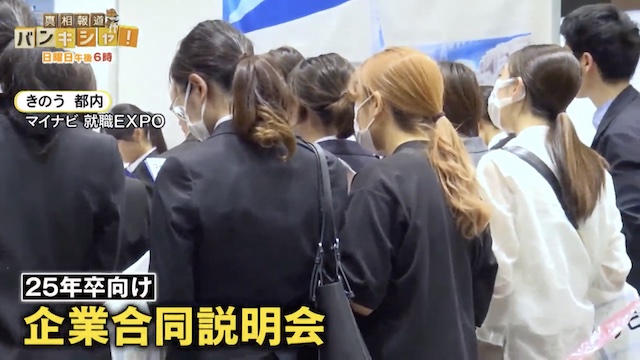
A job fair for university students graduating next spring was held Saturday, drawing attention to the employment choices of today's youth. Many seem to prefer flexible career paths over long-term commitments to a single company. "Honestly, the idea of staying with one company isn't very appealing to me," one participant shared, reflecting a growing trend toward job switching and freelancing.

According to a survey of this year's new employees, only 21.1% wish to stay with their current company until retirement, while 26.4% would switch jobs if the opportunity arises. This preference for job mobility is at its highest in 18 years. A 20-something respondent shared his career plan, which includes working for an event company, changing jobs by 28, marrying by 31, and considering freelance work by 45 after potentially taking care of aging parents.

Smartphones have made job searches more accessible, leading to a rise in applications from a diverse group of people, including students, housewives, and office workers. This ease of access has broadened the spectrum of potential job seekers.

In one notable case, a third-year employee who has already switched jobs twice envisions starting his own business rather than working for someone else. "It would be amazing to start my own company," he expressed, resonating with a friend who found the idea appealing.

In contrast, another young professional plans to take over his family's business in Gunma Prefecture. Despite a 90% drop in revenue due to the pandemic, his father managed to revive the business. "I plan to learn enough about management to surpass my father," he stated, planning to take over by 28 and aiming to strengthen his foundation in the business.

This blend of ambition and pragmatism among Japan's youth highlights their diverse aspirations and the evolving job market. As they navigate through their early careers, these young professionals are setting the stage for a dynamic workforce that embraces flexibility, entrepreneurship, and lifelong learning.

Source: 日テレNEWS

News On Japan
POPULAR NEWS

Japan began applying a new numerical alcohol threshold for dangerous driving offenses on July 21, introducing a clearer standard for cases involving impaired driving that could lead to fatal accidents.

Prime Minister Sanae Takaichi's government approved its first annual basic economic and fiscal policy on Tuesday, pledging "responsible and proactive fiscal policy" and envisioning about 370 trillion yen in public- and private-sector investment in strategic industries through fiscal 2040.

A covert network of shuttle tankers is carrying crude through the increasingly dangerous Strait of Hormuz as renewed fighting between the United States and Iran disrupts shipping and raises concerns over how Japan will secure the oil it needs.

Russian Deputy Foreign Minister Andrey Rudenko has criticized moves by Japanese and Ukrainian companies to cooperate on drone technology, warning that such ties would be regarded by Moscow as a "clear hostile act."

The rainy season ended in the Kanto-Koshin and Tokai regions on July 20 as strengthening high pressure brought intense heat across Japan, with temperatures forecast to reach 38 C in Kumagaya, Saitama Prefecture, and Kofu.

MEDIA CHANNELS
         

MORE Education NEWS

Hokkaido saw a marked shift toward private high schools among students entering in fiscal 2026 after tuition at private institutions became effectively free from April, according to an analysis by the Hokkaido Board of Education.

The Japanese government is considering new rules to protect children from the risks of social media and plans to compile concrete measures by the end of 2026, but officials and experts remain cautious about introducing a blanket age restriction like those pursued in Australia and the European Union.

Japanese elementary and junior high school students continue to struggle with written-response questions in Japanese, while average accuracy rates in arithmetic and mathematics remained in the 50% range, according to nationwide academic test results released by the education ministry on July 16.

Japan’s relationship with intimate goods is far older than the modern online adult shop. Long before discreet packaging, digital payments, and private home delivery, Japanese artists, writers, merchants, and townspeople were already exploring the boundaries between desire, humor, privacy, and everyday life.

A growing number of young doctors in Japan are moving directly into cosmetic medicine after obtaining a medical license and completing their initial clinical training, raising concern that the trend may be worsening staff shortages in insurance-covered medical care.

Foreign drivers seeking to convert overseas licenses into Japanese ones are increasingly turning to driving schools after tougher rules introduced last October sharply reduced pass rates for both written and practical checks.

Foreign-born sumo wrestlers are often praised for speaking remarkably natural Japanese, a sharp contrast to many overseas athletes in other professional sports.

Police in Isehara, Kanagawa Prefecture, presented letters of appreciation to two first-year junior high school students on July 10 after they chased a suspected shoplifter for about 250 meters and helped detain the person.