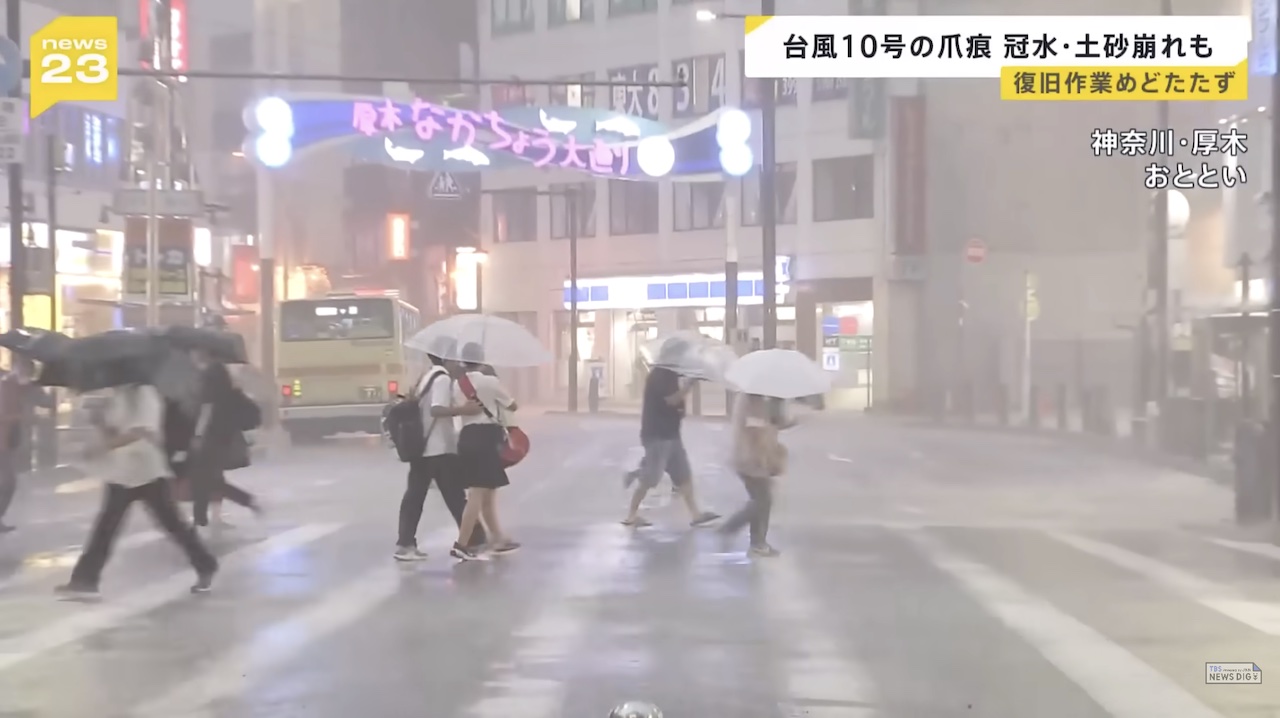
GUNMA, Sep 03, 2024 (News On Japan) - Typhoon No. 10, which brought record-breaking rains across various regions, has left significant damage, including flooding homes and triggering landslides. On Yakushima Island in Kagoshima Prefecture, a 3,000-year-old Yakusugi tree was split in two, leaving a scar on a popular tourist spot.
In Isesaki City, Gunma Prefecture, heavy rain fell alongside flashes of lightning. In Maebashi City, lightning struck as muddy water surged onto the roads.
In Takasaki City, fierce winds and driving rain battered the area, creating conditions reminiscent of a typhoon.
A concerned resident captured the moment, saying, 'Is everything going to be okay? Will it ever stop? I'm scared. The roads are flooded.'
In another location, the roads were completely submerged, resembling a river, with cars splashing through the water.
Heavy rain also pounded the Tohoku region, with the sound of raindrops hitting the ground echoing at a service area in Fukushima Prefecture.
Although Typhoon No. 10 downgraded to a tropical depression on September 1st, it continued to bring heavy rains to northern Kanto and the Tohoku region on September 2nd due to the moist air it carried.
The typhoon, which caused downpours across the Japanese archipelago for about a week, has left lasting damage in many areas.
In Shizuoka City, a hillside collapsed, striking a strawberry greenhouse. On September 2nd, prefectural and city officials conducted on-site investigations.
A reporter on the scene stated, 'I'm at a temple in Shimizu Ward, Shizuoka City. It's sunny here, but the graves, toppled by the landslide, remain in disarray.'
At Tesshuzenji Temple, where around 50 graves were damaged by a landslide, officials conducted inspections, but no timeline for restoration work has been set.
Meanwhile, in Ikeda Town, Gifu Prefecture, aerial footage revealed the area completely submerged.
In Gifu Prefecture on August 31st, the Kunise River overflowed, causing flooding in homes and roads in Ikeda Town and Ogaki City.
Last Friday in Hiratsuka City, Kanagawa Prefecture, record rainfall for August was observed.
A reporter commented, 'The roads are completely flooded, and cars are stranded.'
Flooding was widespread across the city, with many cars damaged. A man whose car was submerged explained, 'I called the manufacturer, and they told me not to move it anymore, to just leave it as it is. With work starting again, I'm really struggling without a car to get around.'
On September 2nd, roadside service operators were busy responding to the situation.
Takahiko Kimura of the emergency towing team at Tomei Odawara Atsugi Branch said, 'It’s completely dead, it won't turn on. The steering might be locked too.'
Another vehicle submerged in the floodwaters was no longer operable.
Kimura added, 'The electrical system is completely dead. The battery might be shot, it just won't turn on.'
The car owner explained that the nearby river had overflowed, causing his car to be submerged.
The owner stated, 'When I looked inside the car, it was soaking wet. The engine wouldn’t start. I’ve given up; there's nothing I can do.'
Opening the hood revealed that the water had reached the battery compartment.
The roadside service operator reported that they had received over 100 calls for assistance so far.
Kimura remarked, 'Honestly, it's been overwhelming. The phone hasn't stopped ringing since morning. We’re still working on 50 to 60 cases at the moment.'
On Yakushima Island, Kagoshima Prefecture, a UNESCO World Heritage Site, the island was battered by a fierce storm.
Taro Watanabe, a guide at Yakushima Guide Office Yamagata, said, 'This wind felt stronger than any typhoon I’ve ever experienced. Even indoors, it was terrifying.'
Watanabe, who works as a local guide, noticed something was amiss after the typhoon passed on Saturday.
He said, 'When I looked towards Yayoi-sugi from the parking lot, I couldn’t see it. When I got closer, I saw it had fallen.'
The Yayoi-sugi tree, a Yakusugi over 3,000 years old and a symbolic presence on the island, was split in two by the storm.
Watanabe commented, 'It’s completely fallen, right at eye level. This is a place we often visit on our guided tours, and it holds a lot of memories. It’s heartbreaking.'
There are growing concerns about the impact on tourism.
Watanabe added, 'Yakushima’s peak tourist season runs from September through November. We’re worried about the potential damage to tourism. We’re working hard on recovery efforts to ensure it doesn’t drag on.'
In the Kanto-Koshin and Tokai regions, atmospheric instability is expected to continue, with more thunderstorms likely on September 3rd. Given the loosened ground from previous heavy rains, continued vigilance against landslides is necessary.
Source: TBS