Jan 28 (News On Japan) - The world of finance is moving faster than ever. While Bitcoin often captures the spotlight as "digital gold," Ethereum has quietly become the most important piece of infrastructure in the digital world.

If you've been following the Ethereum price USD, you're looking at more than just a ticker symbol; you're looking at the valuation of a global, decentralized computer system.
In this guide, we'll break down exactly what Ethereum is, how it works, and why it's changing how we think about money, ownership, and the internet—all in plain English.
More Than Money: The World's Digital Foundation
To understand Ethereum, you first need to realize it isn't trying to be "Bitcoin 2.0." While Bitcoin was designed to be a secure way to send and store value without a bank, Ethereum was designed to be a platform for everything else.
Imagine the internet as we know it today. Most of the apps you use—social media, banking, and streaming—are owned by giant companies that control your data on their private servers. Ethereum is an "Open Internet." It is a giant network of thousands of computers working together as one single "World Computer." No one owns it, no one can shut it down, and anyone can build on it.
Smart Contracts: The Digital Vending Machine
The "superpower" of Ethereum is something called a Smart Contract. You can think of a smart contract like a digital vending machine.
In the real world, if you want to buy a house or a car, you need lawyers, brokers, and mounds of paperwork to ensure both sides follow the rules. A smart contract replaces the middleman with code. You program the rules into the blockchain: "If the buyer sends the money, then transfer the digital deed to the buyer automatically." Because the code is public and "immutable" (meaning it can't be changed once it starts), you don't need to trust a stranger. You just trust the math.
Decentralized Finance: Being Your Own Bank
One of the biggest uses for Ethereum today is DeFi, or Decentralized Finance. In the traditional world, if you want a loan or want to earn interest, you have to go to a bank. They check your credit, take a cut of the profit, and tell you when you can access your money.
In the DeFi world on Ethereum, you are the bank. You can lend your assets to others and earn interest directly, or you can borrow money by putting up your digital assets as collateral—all without ever asking for permission from a human. Today, billions of dollars move through these systems every day, proving that we don't always need a marble building on a street corner to handle our finances.
Digital Ownership and the Power of NFTs
You've likely heard of NFTs (Non-Fungible Tokens). While many people think they are just "expensive JPEGs," the technology behind them is actually about Digital Proof of Ownership.
Before Ethereum, it was impossible to truly "own" a digital file because anyone could copy and paste it. An NFT is like a digital certificate of authenticity that lives on the blockchain. In the future, this won't just be for art; it will be for your house deed, your car title, and even your concert tickets. Ethereum provides the secure "filing cabinet" where these proofs of ownership are kept forever.
The Fuel of the System: Understanding "Gas"
When you look at the Ethereum price USD, you are looking at the price of "Ether" (ETH). Ether is the "fuel" or "gas" that makes the World Computer run.
Every time someone uses an app on Ethereum or sends a payment, they have to pay a tiny fee in Ether. This fee goes to the people who keep the network running and secure. Think of it like this: Ethereum is the highway system, and Ether is the toll you pay to use the road. As more businesses and people start driving on these digital highways, the demand for that "fuel" naturally increases.
Scaling Up: High-Speed Lanes for Everyone
In the past, Ethereum was sometimes slow and expensive because too many people were trying to use it at once. This led to the creation of Layer 2 solutions.
Think of Layer 2 as an "express lane" built on top of the main Ethereum highway. These networks (like Arbitrum or Optimism) bundle thousands of transactions together and settle them all at once on the main chain. This has made using Ethereum incredibly cheap—often costing just pennies—and lightning fast. This move toward efficiency is a major reason why major corporations are now comfortable building their systems on Ethereum.
Real World Assets: Bringing the Physical to the Digital
One of the most exciting trends right now is Tokenization. This is the process of taking a real-world asset—like a piece of real estate, a gold bar, or a government bond—and representing it as a token on the Ethereum blockchain.
Why do this? It allows for "fractional ownership." Instead of needing $500,000 to buy an investment property, a developer could tokenize the building into 1,000 pieces. You could then buy one "token" for $500 and earn your share of the rent automatically through a smart contract. This opens up high-value investments to regular people who were previously locked out.
Zoomex: Precision Engineering for the Digital Age
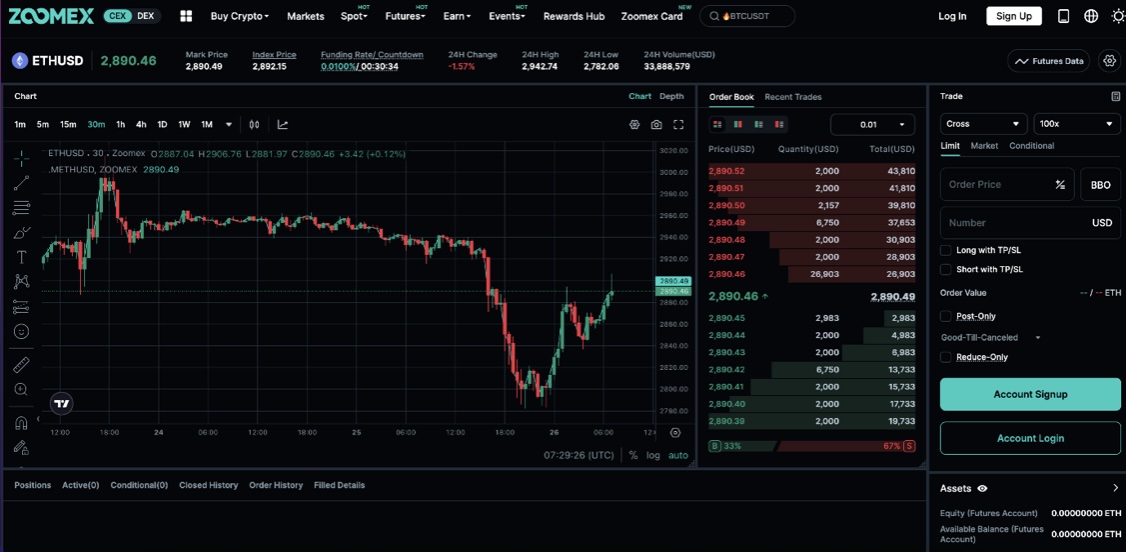
As the Ethereum ecosystem becomes more complex and faster, the tools we use to access it must also evolve. This is where Zoomex stands out in the crowded world of digital finance.
Zoomex isn't just another trading platform; it is built with a focus on high-speed performance and professional-grade reliability. To understand the Zoomex philosophy, look no further than their partnership with the TGR Haas F1 Team.
In Formula 1, success is measured in milliseconds. A car's engine, aerodynamics, and driver inputs must all work in perfect harmony to handle the "volatility" of a race track. Zoomex applies this same "F1 mindset" to the digital markets. When the Ethereum price starts moving rapidly—perhaps due to a major upgrade or a shift in global markets—you need a platform that won't lag or freeze.
How Zoomex Connects You to the Ethereum Engine:
Reliable Execution: Just as an F1 team relies on their car to respond instantly to a steering input, Zoomex users rely on their "matching engine" to execute trades exactly when they hit the button.
Simplified Complexity: Ethereum has many moving parts (Layer 2s, staking, smart contracts). Zoomex acts like a professional "pit crew," handling the technical heavy lifting so you can focus on the race ahead.
Security & Stability: Haas F1 cars are marvels of safety engineering. Similarly, Zoomex prioritizes the security of your assets, using advanced encryption and cold-storage solutions to ensure your "digital fuel" is always protected.
By bridging the gap between high-stakes racing technology and decentralized finance, Zoomex provides a stable entry point for anyone looking to navigate the Ethereum ecosystem with confidence.
The Bottom Line: Your Place in the Future
We are moving away from an era where we have to trust large, opaque institutions to manage our lives. Ethereum offers a future built on transparency, math, and individual ownership.
Whether you are interested in the Ethereum price USD for a quick trade or you are looking to hold ETH as a long-term "dividend" through staking, the most important step is to understand the technology. The "Digital Gold Rush" was just the beginning; the "Digital Infrastructure Age" is where the real value is being built.