KYOTO - Damage caused by 'spring bears' emerging from hibernation is increasing across Japan, with sightings now being reported even near major tourist destinations, while those involved in hunter training warn of growing challenges in cultivating new bear hunters.
As bear sightings continue to be reported near residential areas, attacks on people are also mounting.
On May 6th in Iwate Prefecture, the body of a 69-year-old woman believed to have been attacked by a bear was discovered, while in Yamagata Prefecture, a 70-year-old man gathering wild mountain vegetables suffered fractures to his cheekbone after being attacked.
Reports believed to involve “spring bears” have also surfaced near tourist attractions in Kyoto.
Reporter Haruka Tsuta said: “There is a temple nearby, but three bears were reportedly spotted along the riverbank here.”
On April 25th, three bears believed to be a mother and cubs were seen near the Kiyotaki River in Kyoto’s Ukyo Ward. The adult bears were estimated to measure around 150 to 170 centimeters in length, while the size of the cub was unknown. The bears were reportedly walking slowly along the river before heading upstream.
The area lies close to Jingoji Temple, famous for its autumn foliage, and the World Heritage site Kozanji Temple, a popular destination for river activities and hiking.
Concern among residents has intensified following the sightings.
A nearby resident said: “This is the first time in more than 40 years that bears have appeared here.”
Another bear was reportedly seen by a passing driver on May 4th in the same area, with the sightings also affecting pilgrimage routes linked to the World Heritage site Ninnaji Temple located southeast of the area.
Ninnaji Temple official Kiyohiro Isoya said: “This narrow path is part of the pilgrimage route for the Omuro 88 Sacred Sites, and although it is about six kilometers away, the mountains are connected, so we have suspended the pilgrimage.”
The season typically sees large numbers of visitors entering the mountains, but a walking event scheduled for May 3rd was also canceled.
Isoya added: “Guidelines for responding to bear sightings have not yet been established, so decisions such as whether to ban entry into the mountain if a bear appears have not been finalized. We need to review these measures again.”
While bear sightings have long been reported in the Kansai region, changes are also emerging in the world of hunter training.
A large shooting training facility that opened two years ago in Miki City, Hyogo Prefecture, is being used to train hunters capable of targeting bears, wild boars, and birds.
Reporter Sota Nakano said: “This facility offers shooting training for hunters who hunt bears, wild boars, and birds.”
The facility attracts both licensed hunters and people who enjoy clay shooting as a sport.
On this day, trainees practiced using shotguns commonly employed for hunting deer and wild boars.
An instructor explained: “If the target moves at a constant speed and you aim ahead of it, you can hit it physically. You will definitely hit it.”
Since emergency firearm hunting in urban areas was legalized in September last year, requests for training and seminars from municipalities both inside and outside Hyogo Prefecture have increased, as the facility allows participants to fire actual guns.
One participant, who has hunted for 10 years, said he began because deer and wild boars were destroying farmland.
Another participant, licensed for two years, said: “I wanted to obtain meat with my own hands. They also teach us the process before even handling a gun.”
Despite growing interest in hunting and wildlife damage control, many participants expressed reluctance when asked about hunting bears.
One said: “With my skill level, it’s impossible. If I only injure the bear and it escapes, it becomes even more dangerous.”
Another said: “I don’t want to hunt bears. I don’t even want to go where they are. I don’t know if I could fire calmly, and if you make a mistake after it approaches you, you could be killed.”
Rifles, which possess significantly greater killing power, are commonly used for bear hunting.
Tomohide Iwasaki, management chief at the Hyogo Prefectural General Shooting Range, said: “A rifle can reach one or two kilometers, and its killing power is correspondingly high. Rifles can only be used for deer, wild boars, black bears, and brown bears.”
To possess a rifle in Japan, individuals are generally required to have continuously owned a shotgun for at least 10 years, creating a high barrier for new hunters.
Demonstrating rifle shooting, Nakano remarked: “The sound and impact are very strong.”
Iwasaki explained: “The main target is usually the head. If you hit the stomach, the bear will not collapse immediately and may run hundreds of meters. If you fail to kill it with one shot, you yourself could become the victim.”
As bear numbers continue to rise nationwide, Japan is also grappling with an aging and shrinking hunter population. The facility has introduced simulation programs using replica firearms so that beginners and children unfamiliar with guns can experience clay shooting and hunting, in an effort to nurture the next generation.
One visitor said: “It’s fun because it feels great when you hit the target.”
Another added: “I learned families can come here together, so I thought I’d give it a try.”
When the reporter attempted the wild boar simulation, however, the target ultimately escaped.
Although human injuries caused by bears continue to be reported nationwide following the end of hibernation season, officials say the bears living in Hyogo Prefecture have not yet become accustomed to humans, limiting major incidents so far.
Iwasaki said: “As a member of the culling team, I am active every week, and there are times when a bear suddenly appears. But bears usually recognize humans and run away.”
Even so, training continues in preparation for a worst-case scenario.
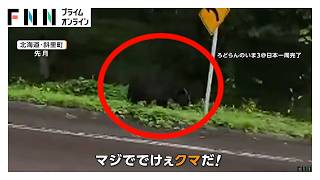
A brown bear was caught on camera running at high speed through a residential area in Hokkaido, as sightings of unusually large bears continue to spread across the region this spring.
Dashcam footage recorded at around midnight on May 8th in Yubetsu, located in Hokkaido’s Okhotsk region, showed the animal racing through a neighborhood street. The driver later alerted police.
Bear droppings were later found at three locations in the town between the early morning and sunrise hours, including near the main gate of Yubetsu High School.
The school suspended club activities while police increased patrols in the area.
“One resident said, ‘It’s true, those are bear tracks. I’ve lived here a long time and never seen anything like this.’”
Another resident added, “We often hear about bears appearing in the mountains farther away, but not around here.”
Town officials believe the droppings and footprints likely belong to the same young bear that recently became independent from its mother.
In nearby Okoppe, another giant bear was captured on camera approaching through a forest near homes on May 2nd. The animal appeared remarkably large despite having only recently emerged from hibernation, with footage showing its thick body swaying as it walked and its sharp claws clearly visible.
Another camera also captured the bear rubbing its back against a tree before wandering away.
“The bear was probably between 1.8 and 2 meters long and may have weighed 250 to 300 kilograms,” said wildlife observer Tetsuya Kurosawa, who filmed the footage.
Kurosawa, who has studied bears for around 20 years, said this year’s animals appear noticeably larger than usual.
“This year, many of the bears on camera look extremely fat,” Kurosawa said. “They are huge, with very round backsides. It makes you wonder what they have been eating.”
Reports of giant bears have continued across Hokkaido. In Tomamae, northern Hokkaido, a bear measuring 2.2 meters in length and weighing 330 kilograms was trapped and killed in April.
Experts say the bears’ massive size may be linked to access to calorie-rich crops before hibernation.
“Compared to just before hibernation, bears generally lose around 30% of their body weight over winter,” said Yoshikazu Sato, a professor at Rakuno Gakuen University who specializes in bear ecology. “Even a bear weighing over 400 kilograms before hibernation would not be unusual. The most likely explanation is that it consumed large amounts of corn grown as livestock feed.”
Sato warned that larger bears require greater amounts of food, increasing the likelihood they may return to farmland and populated areas.
“Compared with smaller bears, large bears need to eat much more,” Sato said. “If corn is more attractive to them than nuts and other food in the mountains, they will continue coming into fields.”
Authorities are urging residents to strengthen measures such as proper garbage management and the use of electric fencing to prevent bears from approaching populated areas.
Source: UHB & FNN