FUKUOKA - In Fukuoka City's Nakasu, there's a bar where you can enjoy a drink while receiving life advice from an active monk. This unique establishment, standing out in Kyushu's largest entertainment district, offers a moment of peace to those troubled by life's challenges.
Attracted by the neon lights, many people come and go in Fukuoka City's Nakasu, Kyushu's largest entertainment district.
When you open the door, a solemn atmosphere greets you.
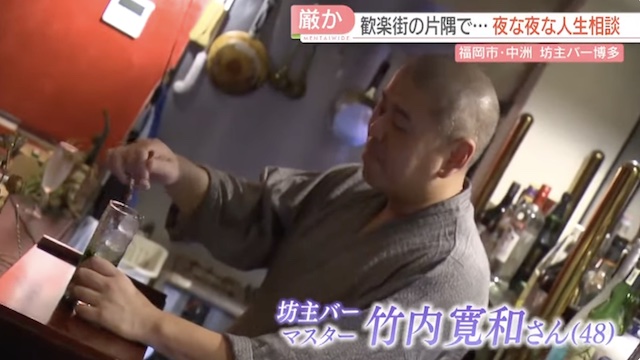
Hakata Monk Bar - Hirokazu Takeuchi (48)
'This is a night temple, called Monk Bar, where we charge an entrance fee for every 30 minutes. During that time, you can enjoy drinks, talk, or seek life advice.'
The man in the samue attire shaking a cocktail shaker is the master of the Monk Bar, Hirokazu Takeuchi (48). Takeuchi is an active monk.
Born and raised in a temple in Nagano Prefecture, Takeuchi trained to become a monk for four years starting at age 18 at a temple in Ehime Prefecture. He has also worked as a company employee in Fukuoka City and traveled the world, visiting 53 countries.
As a freelance monk, he handles several requests for memorial services each month.
Takeuchi
'People often ask if it's okay to have a side job, but it's not a side job. I just use different methods to convey my message as a monk.'
The Nakasu Monk Bar, which Takeuchi opened seven years ago, attracts people seeking advice on their life problems night after night.
A pair of women in their 30s, who work together, came for 'relationship advice.'
Takeuchi
'You need to find opportunities to meet people. If you move quickly, you might meet someone special today. If you wait until tomorrow or the day after, you might miss your chance.'
Takeuchi suggested nearby restaurants and matchmaking agencies where they might meet someone and advised them to value the concept of 'Ichigo Ichie' (treasuring every encounter).
Woman
'For my question about finding someone to meet, he suggested places to go. I'm going to check them out right away. I'm glad I came.'
The menu, written in a goshuincho (a book for collecting temple stamps), features cocktails named after Buddhist themes.
The vibrant and sweet 'Gokuraku Jodo' (Pure Land) is easy to drink, while the 'Shakunetsu Jigoku' (Scorching Hell) features tomato juice and chili pepper to represent the heat and pain of hell.
There are also cocktails made together with the customers.
Takeuchi
'Please hold this and stand here. Join your hands in prayer and make a wish. We will mix your prayer with the smoke to create a special drink.'
The 'Special Drink' is a cocktail made with matcha liqueur, lime, and sake, infused with the scent of incense.
Announcer Mami Abe
'The scent of incense and this drink together make me feel calm.'
A 50-year-old woman who ordered the cocktail 'Shogyomujo' (Impermanence) explained her choice.
Woman
'Because life is impermanent.'
'Shogyomujo' means that nothing lasts forever.
Takeuchi
'Thinking about why we live can be endless.'
Woman
'It's better to enjoy the present more simply.'
Takeuchi
'Yes, exactly. Life is about accumulating experiences by doing what you want and meeting who you want to meet.'
The gentle sweetness of cherry blossoms and the acidity of lemon make this an adult drink that balances sour and sweet.
Woman
'In this age, our relationship with temples has weakened. Alcohol might be just an addition, but talking here provides insights. I'm glad I came.'
Takeuchi
'It's a place where people tired of daily life or those feeling lost can come for advice. I'd be happy if they enjoy a drink that can only be had here in this unique atmosphere.'
In the nightlife district, this unique 'night temple' listens quietly to the concerns of those troubled by life's impermanence.
Source: FBS