News On Japan

'Tourist Express Bus' Aims to Ease Kyoto City Bus Congestion

KYOTO - Kyoto City, facing the issue of overcrowded city buses due to overtourism, has launched a new initiative in June. What are the goals and challenges of this new measure?
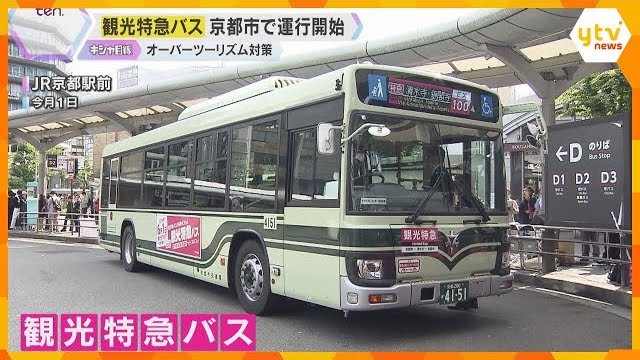
'Tourist Express Bus' Aims to Ease Kyoto City Bus Congestion

On June 1st, the 'Tourist Express Bus' began operations at Kyoto Station. Separate from the regular city buses, these buses run only on weekends and holidays, stopping only near tourist sites. The aim is to segregate 'residents' from 'tourists.'

Overtourism in Kyoto has led to severe congestion, particularly on city buses that residents use daily.

Reporter Nozomi Fujieda: 'Passengers keep boarding, but the bus is already full.'

Both residents and tourists have been troubled by the overlap of routes serving daily commutes and tourist destinations.

'I worry if I can even get on the bus. Maybe I'll walk or take a taxi.'

In response, Kyoto City has introduced the 'Tourist Express Bus,' which stops only at certain designated stops. The new schedule includes direct buses to Gojozaka near the UNESCO World Heritage site Kiyomizudera, and routes to bus stops near Ginkakuji, passing through Gojozaka and Gion.

The fare is 500 yen for adults, more than double the regular fare, but the travel time from Kyoto Station to Gojozaka is reduced to about 10 minutes, and to Ginkakuji, from 44 minutes to about 24 minutes.

A user commented, 'When I first heard it was 500 yen, I thought it was quite expensive, but it was very convenient as it arrived in no time.'

The pricing seems reasonable for tourists, but expanding the routes has introduced new challenges.

Kyoto Mayor Koji Matsui: 'Both city buses and private buses face the same issue: a shortage of drivers...'

There is a shortage of both drivers and vehicles. Even on weekdays, many people were seen waiting in line for buses on the 3rd.

Another user said, 'If the Tourist Express Bus was available on weekdays, we wouldn't have to wait in line so long.' 'The express bus is not effective at all. We need more of them.'

While Kyoto City hopes to operate the Tourist Express Bus on busy weekdays, the shortage of drivers and vehicles restricts it to weekends and holidays only.

Source: YOMIURI

News On Japan
POPULAR NEWS

Record rainfall caused 19 rivers to overflow across Fukui Prefecture, flooding roads and homes, triggering landslides and temporarily forcing authorities to issue the highest-level heavy rain emergency warning from early Sunday morning.

Drones were used to deliver food and daily necessities to an isolated mountain community in Himi City, Toyama Prefecture, on August 30 after torrential rain triggered a landslide that cut off road access, while volunteers continued flood recovery work in neighboring Ishikawa Prefecture.

Two typhoons east of Japan were moving northward on August 30, with Typhoon No. 23 (Banlan) overtaking Typhoon No. 22 (Artau), although neither storm is expected to have a direct impact on Japan.

A 9-minute, 13-second drone video filmed inside Aeon Mall Kumamoto two days after the deadly explosion has provided a detailed view of the destruction, showing collapsed ceilings, heavy dust and widespread damage that may have affected between one-third and nearly half of the shopping center.

Strong Typhoon No. 18 was moving northwest through the East China Sea on the night of August 26, gradually pulling away from Okinawa and the Amami Islands as lingering rain, strong winds and high waves were expected to ease. As of 9 p.m. on August 26, the typhoon was over waters north-northwest of Kume Island and moving northwest.

MEDIA CHANNELS
         

MORE Travel NEWS

Record-breaking rainfall continued across the Hokuriku region on Saturday, with Himi City in Toyama Prefecture receiving more than 500 millimeters over 72 hours, as authorities warned of further heavy rain, landslides and river flooding through August 30.

Severe thunderstorms brought torrential rain, lightning, hail and a tornado to Hokkaido on August 28, disrupting rail and air travel and leaving some passengers stranded overnight at New Chitose Airport, as unstable atmospheric conditions triggered intense downpours across Japan.

JR Kyushu plans to restore full service on the Kyushu Shinkansen from the first train on September 18, nearly two months after the Kumamoto earthquake caused extensive damage to tracks and stations and forced the suspension of services on part of the line.

Bear sightings are increasing across Japan this summer as a shortage of food in the mountains drives the animals closer to areas where people live and visit, with authorities in Aomori Prefecture closing a lookout near Lake Towada after a foreign tourist was attacked.

United Airlines announced on August 25 that it will launch direct flights between San Francisco and Okinawa from March 27, 2027, as the U.S. carrier seeks to capture growing demand for travel to Japan.

ANA Holdings' All Nippon Airways and Japan Airlines will begin coordinating departure times on the Haneda-Okayama route from October 25, an unusual move by Japan's two largest airline groups as weak business travel, a weaker yen and rising fuel and labor costs put increasing pressure on domestic operations.

Haneda Airport has unveiled a new boarding area at Terminal 1 that will begin operations in September, featuring extensive wood interiors and self-driving transportation within the facility.

A new 220-meter pedestrian suspension bridge has been completed at Biwako Valley in Otsu, Shiga Prefecture, offering visitors sweeping views of Lake Biwa from mountains about 1,100 meters above sea level.