News On Japan

Yomiuriland’s Ferris Wheel Makes Final Spin

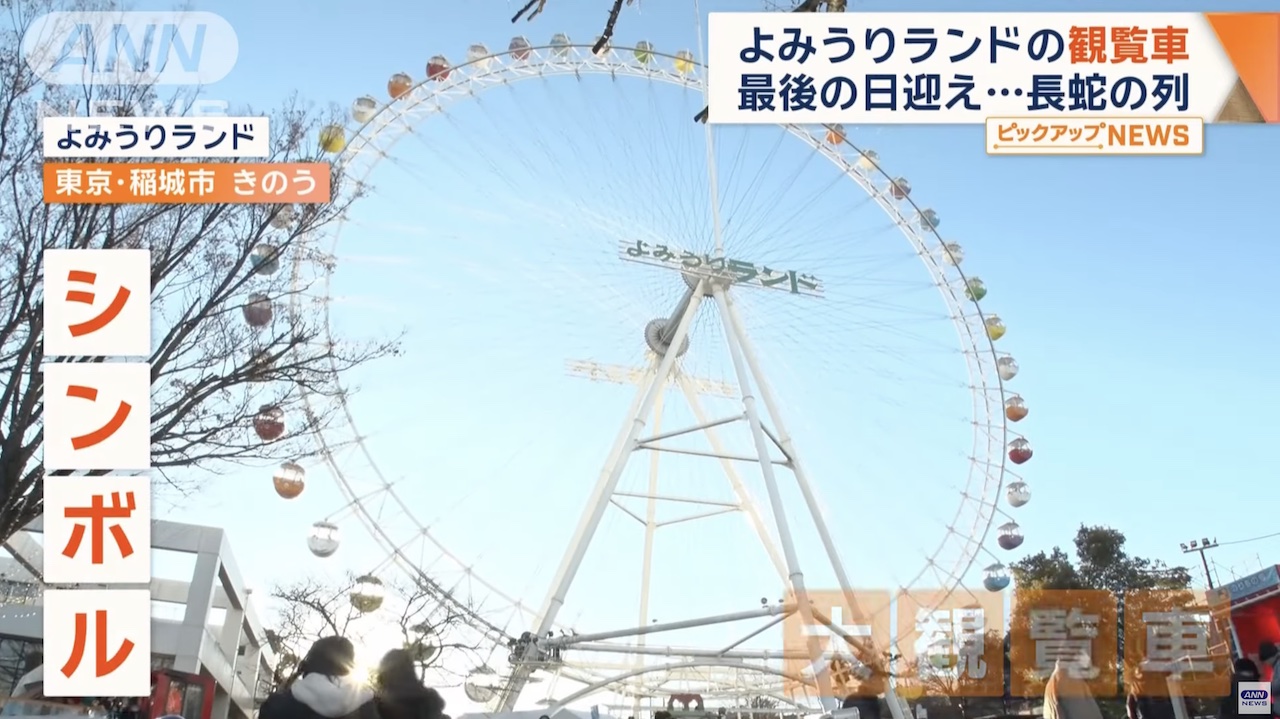
TOKYO, Jan 15 (News On Japan) - Yomiuriland’s iconic Ferris wheel, cherished by visitors for over four decades, marked its final day of operation on Monday, as fans flocked to bid farewell to the beloved attraction and relive old memories.

The Ferris wheel, which stood without major malfunctions for 44 years, drew large crowds on its last day. It had been a symbol of Yomiuriland since its launch in 1980, boasting a height of 61.4 meters—making it the tallest in Japan at the time.

A visitor in their 20s recalled: "I came here for my first Christmas date, but it was too crowded, and we couldn’t ride it back then. Today, I finally got to ride it with the illumination, so it was a great experience."

Another visitor in their 40s shared: "I used to ride it countless times with my daughter when she was younger. Upon hearing today would be the last chance, we rushed over."

Even younger visitors expressed their joy, with a 5-year-old simply saying: "It was fun."

Maintained with minimal issues over the years, the Ferris wheel was considered a reliable fixture at the park. Eiichi Toe, 59, who had been in charge of its maintenance since joining the company in 2011, praised its performance: "Among the park’s attractions, it was called a model machine. With proper maintenance, it ran safely with few problems. It’s remarkable how it kept running for 44 years with only minor repairs."

On its final day, clear weather provided a spectacular view of Mount Fuji. However, the decision to retire the Ferris wheel was driven by age and the lack of air conditioning, which made it difficult to operate during hot summers. Yomiuriland plans to replace it with a modern Ferris wheel named "Sky Go Round," which will become the park’s new landmark.

Some visitors went to great lengths to make the most of the day. One visitor rode the Ferris wheel five times within an hour after arriving at 6:30 PM. "This was the first Ferris wheel I ever rode. Since it’s closing, I wanted to create lasting memories, so I kept riding it. I’m planning to keep my ticket as a memento," the visitor said.

At 8:30 PM, a farewell ceremony was held in front of the illuminated Ferris wheel. Yomiuriland Director Toru Kitahara reflected: "Every morning, our staff gathered beneath the Ferris wheel for meetings before dispersing across the park. In the evening, we’d all return here. In that sense, it was like a home to us."

The Ferris wheel’s height of over 60 meters highlighted a regulatory hurdle known as the "60-meter barrier." A 2007 amendment to the Building Standards Act mandated approval from the Minister of Land, Infrastructure, Transport and Tourism for amusement facilities exceeding 60 meters in height. Yuko Fukui, a Ferris wheel researcher, noted that the increased time and costs for obtaining permits have led to a decline in the number of Ferris wheels over 60 meters.

Interestingly, several retired Japanese Ferris wheels have found a second life abroad, particularly in Southeast Asia. The "Space Eye" Ferris wheel from Space World, a now-closed theme park in Kitakyushu, Fukuoka Prefecture, was relocated to a commercial complex in Cambodia in 2020, where it operates under the name "Angkor Eye" and enjoys local popularity.

Fukui explained the appeal of Japanese Ferris wheels overseas: "Japanese Ferris wheels are highly regarded for their safety and meticulous maintenance. Even as secondhand equipment, they are considered reliable. With Southeast Asia experiencing vibrant growth similar to Japan’s post-war boom, these attractions draw large crowds seeking entertainment."

Source: ANN

News On Japan
POPULAR NEWS

Chinese tourists are disappearing from major destinations across the Kansai region as diplomatic tensions between Japan and China continue to deepen on the heels of comments by Prime Minister Takaichi regarding a potential Taiwan contingency, prompting Beijing to urge its citizens to refrain from traveling or studying in Japan.

The Japanese government is preparing to release a new damage projection for a major earthquake striking directly beneath the Tokyo metropolitan area by the end of the year, and interviews with officials familiar with the assessment indicate that in the worst-case scenario the death toll could reach 18,000, while economic losses are estimated at 83 trillion yen.

Toyota unveiled its new GR GT supercar on December 5th at Woven City, the next-generation technology testbed located in Susono, Shizuoka Prefecture, marking the model’s world debut as the automaker targets a release around 2027, positioning the vehicle as the pinnacle of its GR sports-car lineup and its first true supercar since the Lexus LFA launched in 2010.

The proposal to strengthen regulations on international eel trade has been formally shelved, marking a result in line with the position pushed by Japan and several other countries.
EU member states and others had called for tighter controls on all eel transactions under the Washington Convention, citing global resource depletion and the need for stronger international oversight. However, Japan countered that the Japanese eel faces no imminent risk of extinction and opposed the measure.

Tokyo’s Tsukiji Outer Market has taken the unusual step of asking tourists not to visit in December as operators move to prevent crowd-related accidents during the busy year-end shopping season, with local officials also confirming that Shibuya’s New Year’s Eve countdown will be canceled for the sixth consecutive year.

MEDIA CHANNELS
         

MORE Travel NEWS

Autumn travel to Nikko, which draws visitors from across Japan for its bright foliage, is seeing an unexpected wave of vehicle troubles on mountain roads, with everything from flat tires and sudden breakdowns to off-road mishaps and stranded foreign tourists prompting repeated calls for roadside assistance during busy weekends in November.

China’s major airlines have extended the period during which Japan-bound tickets can be cancelled free of charge, with carriers announcing by today that the deadline—initially set to run through the end of this year—will now continue until March 28th 2026.

Osaka’s Minami district, one of the busiest entertainment areas in Kansai, is grappling with a worsening garbage problem as the sharp increase in foreign visitors coincides with a rise in litter throughout the area, and when the reporting team walked through the neighborhood last week they found trash piling up in abandoned bicycle baskets and food containers tossed into alleyways just off the main shopping streets.

A mass of cold air on December 4th brought midwinter-level temperatures across Hokkaido, sending the entire region below freezing and prompting warnings of heavy snow and blizzard conditions along the Sea of Japan coast.

Tokyo’s Tsukiji Outer Market has taken the unusual step of asking tourists not to visit in December as operators move to prevent crowd-related accidents during the busy year-end shopping season, with local officials also confirming that Shibuya’s New Year’s Eve countdown will be canceled for the sixth consecutive year.

Kobe welcomed a new waterfront destination this year as the redevelopment of the former Shinko No. 2 Pier area gave rise to TOTTEI, a spacious coastal district designed to connect the city more closely with the sea while offering visitors a range of leisure attractions that highlight the port city’s unique blend of ocean and mountains.

The annual winter-only Sennin Bath opened along the riverbed of Kawayu Onsen in Tanabe, Wakayama, on December 1st, drawing visitors with its open-air pools heated by hot spring water bubbling up naturally from beneath the river.

The winter tradition of kotatsu-equipped boats has begun in Yanagawa, Fukuoka Prefecture, where small hibachi braziers are placed beneath the tables on shared boats as the seasonal service gets underway.