SEOUL, May 19, 2026 (News On Japan) - As the prolonged disruption of shipping through the Strait of Hormuz continues to strain global energy markets, differences are emerging between how Japan and South Korea are responding to the growing risk of fuel shortages and rising prices.
Japanese Prime Minister Sanae Takaichi and South Korean President Lee Jae-myung agreed during a summit meeting on May 19th to strengthen cooperation on energy supplies, including oil products and jet fuel, amid mounting concerns over Middle East instability and the long-term impact of disruptions in the Strait of Hormuz.
While Japan has continued to stress that supplies remain stable and that there is no need for public restraint, South Korea has taken the opposite approach, launching a nationwide energy-saving campaign and urging citizens to cut fuel and electricity use in daily life.
South Korea introduced a 12-point conservation campaign less than a month after the outbreak of hostilities involving Iran. The measures encourage people to use public transportation, reduce shower times, charge electric vehicles during daytime hours to avoid evening demand peaks, and limit private vehicle use.
Public institutions in South Korea have also reduced government vehicle operations by half, while some public parking facilities restrict access based on license plate numbers on designated days. More than 50 major companies and business groups reportedly agreed last month to reduce the use of company vehicles for commuting and business travel.
Interviews conducted in South Korea showed many citizens broadly accepting the measures, with some citing memories of the country’s experience during the Asian financial crisis in the late 1990s as a reason for the strong public response to government appeals.
By contrast, the Japanese government has repeatedly emphasized that current stockpiles remain sufficient. Takaichi said earlier this month that the country was not yet at a stage where it needed to ask citizens to conserve energy, adding that supplies of crude oil and naphtha-derived products could continue beyond current disruptions.
Critics appearing on TBS's "Hodo 1930" questioned whether Japan’s reluctance to encourage conservation reflects lingering fears of public panic dating back to the 1973 oil shock, when panic buying and shortages became widespread.
Economic commentator Nakazora Naoko warned that if the crisis drags into the summer, Japan could face serious shortages affecting fuel, plastics, chemicals, fertilizers, and logistics. She argued that encouraging moderate conservation now could help reduce the risk of more severe disruptions later.
Journalist Goto Kenji, who has covered Japanese politics for more than four decades, said the government may be underestimating the public’s ability to respond calmly if given clear explanations. He also criticized the administration for failing to hold detailed press conferences explaining the situation and the reasoning behind its policies.
Experts also warned that the impact of the Hormuz disruption extends far beyond gasoline prices. Naphtha shortages are already raising concerns over plastics and printing materials, while rising urea prices threaten diesel logistics because urea is essential for many diesel engine systems.
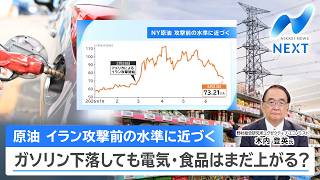
The program also highlighted growing anxiety in financial markets. Brent crude prices recently climbed above 109 dollars per barrel, while some financial institutions have warned prices could reach 150 dollars if disruptions continue into late June.
HSBC forecasts average Brent prices of around 95 dollars per barrel this year, while analysts at Citi warned that continued supply disruptions could sharply slow the global economy and accelerate inflation.
Professor Tanaka Koichiro of Keio University said the longer the Strait of Hormuz remains effectively blocked, the greater the incentive for oil producers and importers to permanently develop alternative export routes bypassing Iran. He noted that Gulf states such as Saudi Arabia and the UAE are already exploring expanded pipeline routes and overseas storage facilities to reduce reliance on the strait.
Tanaka added that while Iran benefits from higher oil prices in the short term, a prolonged closure risks weakening its strategic leverage if alternative supply routes eventually replace the importance of Hormuz.
The discussion also touched on the growing strain on Japan’s finances as the government considers new subsidies for electricity and gas bills this summer. Analysts warned that further spending financed through additional bond issuance could accelerate upward pressure on long-term interest rates and deepen concerns over Japan’s fiscal position.
Participants on the program argued that Japan now faces difficult decisions requiring both short-term conservation measures and longer-term energy strategy reforms, including diversification of supply routes, regional energy cooperation, and reduced dependence on Middle Eastern oil.
Source: TBS